


.png)
How I Care for 50+ Houseplants in Just 10 Minutes a Month
On the first day of each month, I spend about 10 minutes watering more than 50 houseplants. If you are trying to understand how to care for houseplants when a collection grows, the answer is not memorizing dozens of dates. It is building a routine that reduces repeated decisions.
That is it. I do not keep 50 watering reminders. I do not spend every morning pushing a finger into the soil, lifting pots to compare their weight, or wondering whether a yellow leaf means too much water or not enough.
I still notice my plants. I look at their leaves, turn them toward the light, remove old growth, and watch for pests. But watering—the part of plant care that used to create the most doubt—is now the least demanding part of my routine.
It took a growing collection and years of trial and error to get here. Everything in this article comes from my firsthand routine: I have cared for a collection that grew from a few plants in 2017 to more than 50 today. My answer to how to care for houseplants is based on what I actually do in my own home, including frequent work travel—not a theoretical schedule.
My Collection Started With a Few Plants in 2017
In 2017, I had only a few plants. Caring for them felt personal and manageable. I could remember which one I had watered, which one liked a brighter window, and which one could wait another week.
Then a few plants became 10. Ten became 20. Now I have more than 50.
They did not arrive all at once. One filled an empty corner. One was a gift. Another marked a move, a season, or a memory I wanted to keep close. The collection grew because I genuinely love living with plants.

The problem was not loving 50 plants. The problem was trying to manage 50 separate watering decisions.
What Caring for 50 Plants Used to Feel Like
With regular pots, watering followed me around as a daily question.
Should I check the soil today? Is the top dry while the bottom is still wet? Does this pot feel lighter than it did yesterday? Is the moisture meter reading the soil, an air pocket, or a damp piece of bark?
When you own a few plants, those checks can feel responsible. With more than 50, they become a second job.
I tried the shortcuts most plant parents try:
Water everything on the same day.
Put reminders on a calendar.
Test the soil with a finger.
Lift or gently shake a pot to estimate how much water remains.
Use a moisture meter when I still was not sure.
None of those routines solved the real problem. They only gave me more measurements to interpret. I was still the person deciding when, how much, and whether every plant was too wet or too dry. Most advice about how to care for houseplants adds another check, reminder, or tool. My experience has been the opposite: a reliable system should remove decisions while still leaving you free to notice light, leaves, pests, and growth.
Now I do not need that daily routine. I have one simple monthly system.
My 10-Minute Monthly Plant-Watering Routine
The first day of the month is my watering day. I move through the collection once, using each plant's moisture preference and its Posie Pot size to follow the correct watering guide. For me, learning how to care for houseplants at this scale meant separating two questions: what does this plant prefer, and what size Posie Pot is it growing in? Both determine the amount I add.
That second part matters. A small planter and a large planter do not receive the same amount of water. The familiar dry, moist, and wet plant categories are only half of the decision. The exact amount also changes with the size of the Posie Pot.
What I check | What it tells me | What I do |
Plant moisture preference | Whether the plant belongs in the dry, moist, or wet guide | Start with the matching plant category |
Posie Pot size | How much soil and reservoir space I am working with | Use the watering chart for that specific pot size |
Light, season, and plant condition | Whether the plant is using water differently than usual | Notice changes instead of automatically adding more water |
Fill tube | Whether the path to the interior reservoir is clear | Add the measured amount slowly, then replace the stopper |
I do not use one universal “1 cup” or “3 cups” rule across every planter. I use the printed guide or QR guide that corresponds to the pot size, then follow the dry, moist, or wet recommendation within that guide.


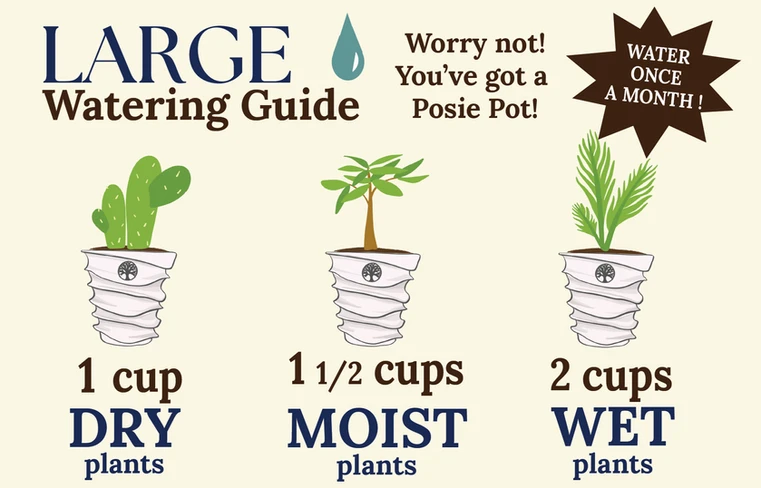
If you need the charts, the Posie Pot setup and watering guide shows the instructions by planter size. If a plant is ready for a different pot, the planter size guide can help you choose the right fit.
I pour the measured water through the fill tube into the hidden interior reservoir. From there, the roots and soil take water from the interior reservoir when they need it.
The plant is not sitting in a bowl of water. Posie Pot is also not relying on a cotton wick inside a decorative outer pot. The reservoir is part of the planter, and the filling tube lets me add water without repeatedly soaking the top of the soil.
Once I finish the collection, I am done with watering for the month.
How to Care for Houseplants Without a Daily Watering Routine
Worry-free watering does not mean ignoring a plant.
As I move around the room, I give each plant a quick visual check. I look for a leaf leaning toward the window, a stem that needs support, dust, pests, yellowing, or a plant that has clearly outgrown its space.
This is much easier when water is not the answer to every symptom.
A brown edge might come from dry indoor air. A stretching stem may need brighter light. Sudden leaf drop can follow a cold draft or a seasonal change. When I am not constantly asking, “Does it need another drink?” I can pay attention to what the plant is actually showing me.
My routine is simple:
Follow the correct watering guide for the plant type and Posie Pot size.
Add water through the fill tube to the interior reservoir.
Look over the leaves, stems, light, and surrounding area.
Trim or turn the plant only if it needs it.
Move on.
Fifty plants no longer feel like 50 emergencies waiting to happen.
I Travel Often, and I No Longer Write a Watering Manual
Travel used to make the problem bigger. Travel changes how to care for houseplants because no friend or sitter knows your collection as well as you do. A stored water source removes the need for them to guess at every pot.
Before leaving, I would mentally walk through every room. Which plants should I water early? Which should wait? If someone stopped by, how would I explain that “a little water” meant something different for every pot?
The friend helping me might visit once a week, but that did not mean they knew how much to pour. Too much water could leave me returning to wet soil and fungus gnats. Too little, combined with a bright window, could leave scorched or drooping leaves—even while deeper soil was still damp.
Now, I follow my normal monthly routine and let the roots and soil take water from the interior reservoir as needed. I can focus on the trip instead of imagining 50 thirsty plants back home.
Light, temperature, season, and the length of the trip still matter. I am not claiming that a planter makes every other condition disappear. What has disappeared is the need to ask another person to guess their way through my entire collection.
For longer trips, I still use a quick pre-travel check. This vacation plant care guide covers the details.
What Posie Pot Handles—and What I Still Handle
Posie Pot did not make me stop caring about plants. It gave me more time to enjoy caring for them.
Posie Pot helps with | I still pay attention to |
Keeping a measured water source in the interior reservoir | Giving each plant appropriate light |
Letting roots and soil take water as needed | Watching leaves and new growth |
Removing daily moisture checks from my routine | Checking for pests and cleaning foliage |
Making travel easier without asking someone to guess | Repotting when a plant outgrows its current size |
Turning 50 watering decisions into one monthly session | Adjusting for meaningful seasonal or environmental changes |
That distinction is important. Worry-free plant care does not mean doing nothing. It means the most confusing job is no longer demanding your attention every day. This is why my practical answer to how to care for houseplants begins with a repeatable watering system but does not end there. Light, pests, temperature, and repotting still deserve attention.
Common indoor plants sold in garden centers have been tested in Posie Pot. The key is to follow the guide for the plant's moisture preference and the size of the planter rather than treating every plant exactly the same.
The Biggest Change Is Mental
My collection feels like part of my home again—not a list of tasks spread across every windowsill. The most sustainable way I have found to think about how to care for houseplants is to make the most stressful task predictable, then use your attention for the signals that actually change.
I can notice a new leaf without immediately checking the soil. I can leave for a work trip without sending someone a room-by-room watering plan. I can bring home another beautiful plant without adding another reminder to my phone.
On the first of the month, I spend about 10 minutes adding the right amount of water to each Posie Pot. Then I go back to enjoying the plants and the stories attached to them.
That is what worry-free means to me. It is not caring less. It is having a system that makes caring for more than 50 plants fit into real life.
What This Firsthand Routine Can—and Cannot—Promise
This routine reflects my experience caring for more than 50 houseplants, not a laboratory result or a promise that every home behaves the same way. I use the same monthly starting point, but I still pay attention when a plant, room, or season changes.
A Posie Pot makes watering the least demanding part of my routine. It does not replace appropriate light, healthy soil, pest checks, or repotting when roots need more room. Being clear about that boundary is part of giving plant parents advice they can trust.
Frequently Asked Questions
How often do you water more than 50 houseplants?
I water my Posie Pot collection on the first day of each month, and the whole routine takes about 10 minutes. Plant conditions can vary, so I still notice meaningful changes in light, temperature, season, and plant health.
Do all Posie Pots receive the same amount of water?
No. The amount depends on both the plant's dry, moist, or wet preference and the size of the Posie Pot. I use the printed or QR watering chart for that specific planter size rather than applying one number to the entire collection.
Do you still use a moisture meter or check the soil with your finger?
No. I no longer use those as part of a daily watering routine. The measured reservoir system removes the need to keep testing every pot before deciding whether to pour more water.
Can Posie Pot help when you travel frequently?
It has made frequent travel much easier for me because the roots and soil can take water from the interior reservoir when they need it. I no longer need a friend to guess how much water 50 different plants require.
Can common houseplants grow in Posie Pot?
Common indoor plants found in garden centers have been tested in Posie Pot. Follow the plant category and size-specific watering guide so each plant receives an appropriate starting amount.
What if I am unsure which guide fits my plant?
Email info@posiepot.com with a photo, the plant name, and where it lives in your home. The free Posie Pot Plant Clinic can help you choose the right starting point.
A Collection I Can Enjoy, Not Constantly Manage
More than 50 plants still need light, room to grow, and a person who notices them. What they do not need is for me to worry about watering every day.
My monthly routine gives each plant a measured starting point while the roots and soil take water from the interior reservoir as needed. The result is not a house with fewer plants. It is a house full of plants that feels calm.

